



In the era of digital transformation, businesses are increasingly relying on intelligent systems to engage users, automate workflows, and provide instant support. Chatbots and AI agents have emerged as two of the most impactful technologies in this space. Although their names are sometimes used interchangeably, they differ significantly in functionality, intelligence, and application.
What is a Chatbot?
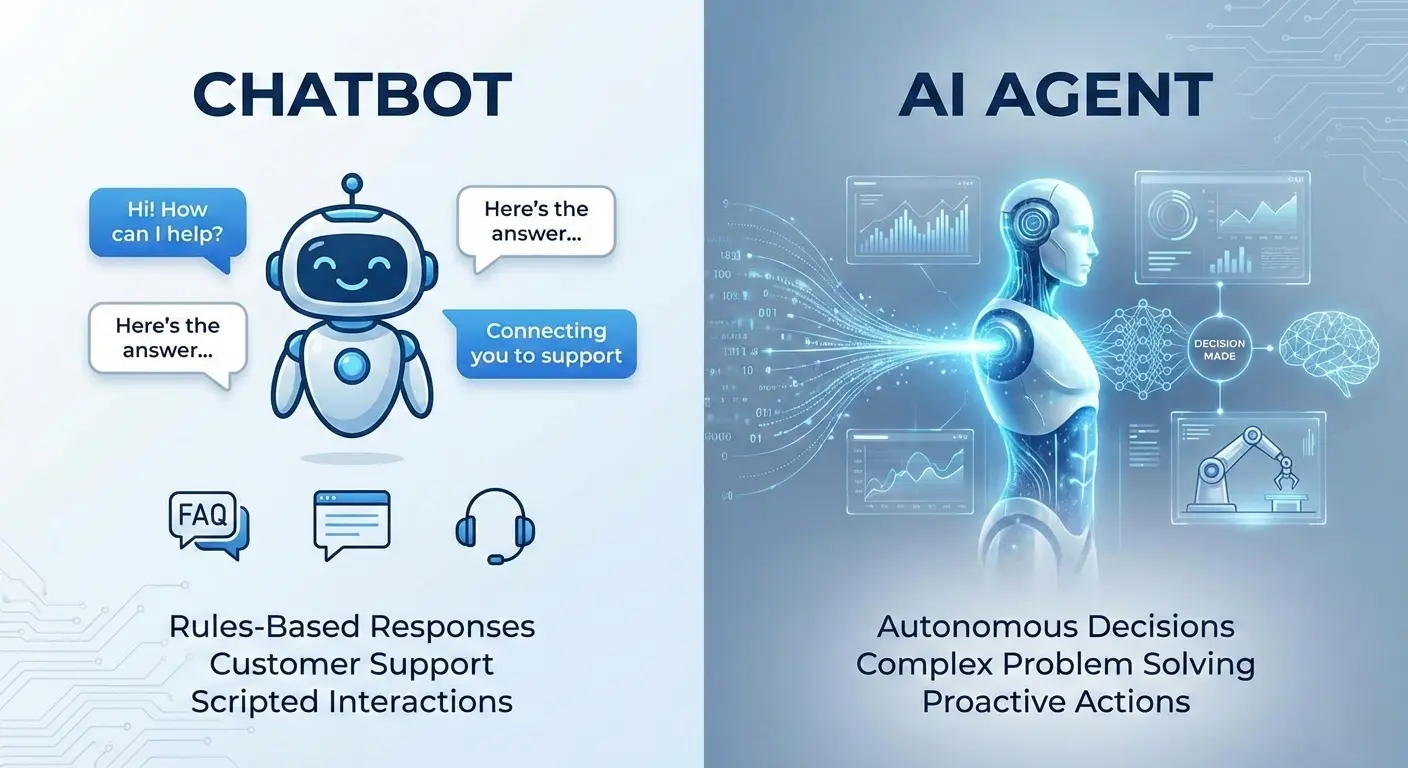
A chatbot is a software application designed to interact with humans through natural language, either via text or voice. Chatbots can follow predefined scripts or leverage basic natural language processing (NLP) to respond to user inquiries. They are commonly deployed in customer support, eCommerce platforms, and websites to answer frequently asked questions, guide users, and provide real-time assistance.
Real-World Examples of Chatbots:
- ChatGPT on websites – Assists with basic queries and conversational experiences.
- Tidio – AI chat combined with live human support for eCommerce.
- Zendesk Answer Bot – Helps resolve repetitive customer queries automatically.
These tools highlight how chatbots can enhance customer experience while saving time and resources.
Key Features of Chatbots:
- Handles repetitive queries efficiently
- Provides 24/7 customer support
- Integrates seamlessly with websites, apps, and social media platforms
- Limited understanding of complex or multi-step tasks
- Cost-effective solution for routine user interactions
What is an AI Agent?
An AI agent is an advanced software system that perceives its environment, processes data, makes autonomous decisions, and acts to achieve specific goals. Unlike chatbots, AI agents are capable of learning from interactions, adapting to new situations, and performing complex, multi-step tasks without human intervention. They often leverage machine learning, natural language understanding, and sometimes computer vision or other AI technologies to operate intelligently.
Real-World Examples of AI Agents:
- Siri, Alexa, Google Assistant – Assist with tasks ranging from reminders to controlling smart devices.
- Rasa AI – Open-source platform for creating intelligent, context-aware agents for enterprises.
- Autonomous Customer Service Agents – AI systems that can resolve complex customer issues, escalate appropriately, and learn from past interactions.
Key Features of AI Agents:
- Understands context and adapts to complex situations
- Performs multi-step decision-making autonomously
- Continuously learns and improves over time
- Can be integrated into business operations, virtual assistants, or automation platforms
- Capable of proactive actions, not just reactive responses
Chatbots vs AI Agents – Key Differences
| Feature | Chatbot | AI Agent | |---------|---------|----------| | Purpose | Answer user queries, provide basic support | Perform autonomous tasks and decision-making | | Intelligence | Rule-based or basic NLP | Advanced, context-aware, adaptive | | Learning | Minimal or no learning | Continuous learning and improvement | | Complexity | Handles simple, scripted interactions | Handles multi-step, dynamic tasks | | Use Cases | Customer support, FAQs, eCommerce assistance | Virtual assistants, AI-driven automation, complex decision-making |
In essence, chatbots are primarily conversational tools, whereas AI agents combine understanding, reasoning, and action to achieve objectives autonomously.
Benefits of Using Chatbots and AI Agents
- Improved Customer Engagement: Instant responses and 24/7 availability increase user satisfaction.
- Cost Savings: Automating repetitive tasks reduces the need for large support teams.
- Efficiency: AI agents handle complex workflows faster than humans, freeing up resources.
- Data Insights: Both chatbots and AI agents collect valuable interaction data for analytics and business improvement.
- Scalability: Businesses can scale operations without significantly increasing manpower.
Future Trends
With AI technologies advancing rapidly, we can expect chatbots to become more context-aware and capable of handling complex queries. AI agents will increasingly manage entire workflows autonomously, integrating with CRM systems, predictive analytics, and IoT devices. Businesses adopting these tools early will gain a competitive edge by providing smarter, faster, and more personalized experiences.
In conclusion, understanding the distinction between chatbots and AI agents is critical for businesses looking to leverage AI effectively. Chatbots are ideal for straightforward, repetitive interactions, while AI agents excel in complex, autonomous, and adaptive tasks. Choosing the right solution depends on your business goals, task complexity, and the desired user experience.