


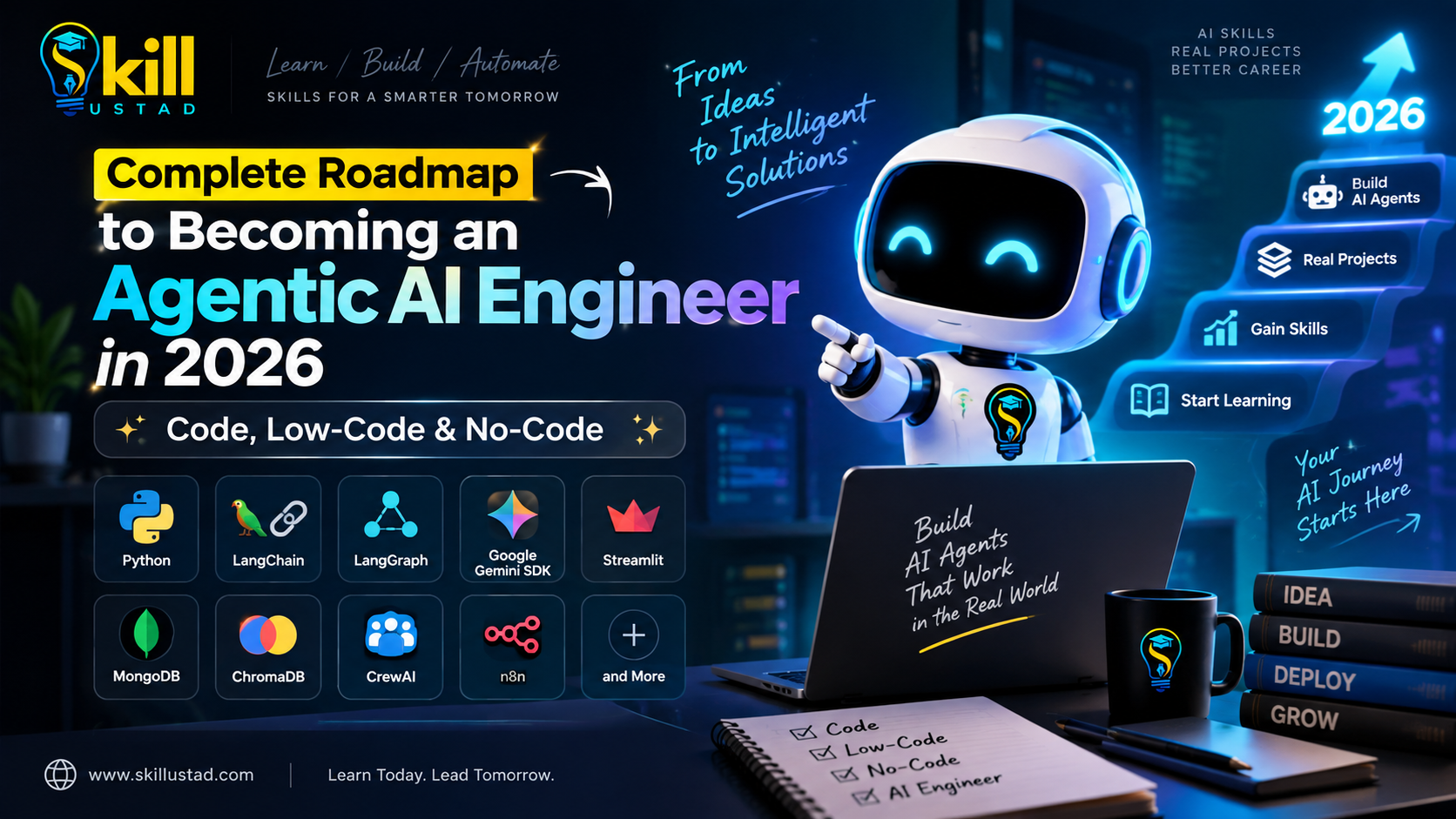
Artificial Intelligence has moved beyond simple chatbots. In 2026, organizations are building intelligent AI agents capable of reasoning, planning, using tools, retrieving knowledge, collaborating with other agents, and completing complex business workflows autonomously. This new era has created one of the fastest-growing technology careers: the Agentic AI Engineer. Unlike traditional AI developers, Agentic AI Engineers combine software engineering, LLM orchestration, databases, workflow automation, and business process design into complete AI systems.
Section 1: Build Strong Programming Foundations
Every successful Agentic AI Engineer begins with programming fundamentals.
1.1 Learn Python
Python remains the industry's primary AI language because of its simplicity and enormous ecosystem. Learn variables, loops, functions, OOP, file handling, APIs, asynchronous programming, virtual environments, and package management.
1.2 Understand APIs
Modern AI systems connect dozens of services together. Learn REST APIs, JSON, authentication, environment variables, HTTP requests, and API integrations.
1.3 Git & GitHub
Version control is essential. Learn branching, commits, pull requests, collaboration, and deployment workflows.
Section 2: Master Large Language Models (LLMs)
Before building AI agents, understand how modern language models work.
2.1 Prompt Engineering
Learn structured prompting, system prompts, chain-of-thought prompting, role prompting, few-shot prompting, output formatting, and function calling.
2.2 Google Gemini SDK
Learn the Google Gemini SDK for Python to build production-ready AI applications. Understand chat models, multimodal inputs, image understanding, structured outputs, tool calling, streaming responses, and long-context reasoning.
2.3 Model Selection
Understand when to use fast models, reasoning models, multimodal models, and cost-optimized models depending on the application.
Section 3: Build AI Applications
After understanding LLMs, start building real applications.
3.1 Streamlit
Use Streamlit to quickly build AI dashboards, chatbots, document analyzers, and internal business tools.
3.2 FastAPI
Build scalable backend APIs for AI applications. Learn routing, dependency injection, authentication, middleware, async programming, and deployment.
3.3 Deployment
Deploy applications on cloud platforms while managing API keys, secrets, monitoring, and scalability.
Section 4: Retrieval-Augmented Generation (RAG)
Production AI systems need access to business knowledge instead of relying only on model training.
4.1 Document Processing
Learn document chunking, metadata extraction, embeddings, semantic search, and document indexing.
4.2 Vector Databases
Use ChromaDB to store embeddings for semantic retrieval. Understand similarity search, collections, metadata filtering, and retrieval optimization.
4.3 MongoDB
Store users, conversations, workflows, application data, logs, permissions, and structured business information.
4.4 Complete RAG Pipeline
Build document upload systems that retrieve relevant knowledge before generating accurate AI responses.
Section 5: LangChain Ecosystem
LangChain provides building blocks for production AI systems.
5.1 Chains
Create reusable workflows combining prompts, LLMs, tools, retrievers, and output parsers.
5.2 Memory
Build conversational systems that maintain context across long discussions.
5.3 Tools
Connect AI with calculators, databases, APIs, search engines, CRMs, calendars, email systems, and custom business services.
5.4 Agents
Build intelligent agents capable of selecting tools dynamically to solve user problems.
Section 6: LangGraph — Production Agentic Systems
LangGraph is becoming the standard framework for complex AI agent orchestration.
6.1 State Management
Understand shared state, checkpoints, persistence, and memory between nodes.
6.2 Multi-Step Workflows
Build workflows where multiple agents collaborate to solve complex business problems.
6.3 Human-in-the-Loop
Create approval systems where humans review sensitive actions before execution.
6.4 Production Orchestration
Design resilient, scalable, fault-tolerant AI systems capable of handling real enterprise workflows.
Section 7: Low-Code Agent Development
Not every AI workflow requires extensive programming.
7.1 CrewAI
Use CrewAI to design collaborative multi-agent teams where each agent has specialized responsibilities such as Researcher, Analyst, Writer, QA Engineer, or Project Manager.
7.2 Business Automation
Rapidly prototype AI workflows for lead generation, report writing, customer support, research automation, and sales operations with minimal code.
Section 8: No-Code AI Automation
Modern businesses increasingly automate operations without writing code.
8.1 n8n
Learn n8n to connect AI models with Gmail, Slack, WhatsApp, Google Sheets, CRMs, databases, calendars, webhooks, and hundreds of SaaS applications.
8.2 AI Workflow Automation
Build fully automated pipelines that receive user requests, trigger AI agents, process documents, update databases, send notifications, and generate reports automatically.
Section 9: Real-World Projects
The fastest way to become job-ready is by building complete projects.
- AI Customer Support Agent
- AI Document Chat (RAG)
- Multi-Agent Research Assistant
- AI Sales Automation System
- Resume Screening Agent
- AI Email Assistant
- AI Content Generator
- AI Knowledge Base
- AI CRM Assistant
- AI Workflow Automation using n8n
- CrewAI Business Automation
- LangGraph Enterprise Workflow
- Streamlit AI Dashboard
Section 10: Career Preparation
Technical skills alone are not enough.
10.1 Portfolio
Publish complete projects on GitHub with proper documentation and deployment.
10.2 Cloud Fundamentals
Understand Docker, cloud deployment, APIs, authentication, monitoring, logging, and production architecture.
10.3 System Design
Learn how enterprise AI systems integrate LLMs, databases, vector stores, workflow engines, external APIs, and frontend applications into scalable architectures.
Conclusion: Becoming an Agentic AI Engineer
The future belongs to engineers who can combine coding, low-code platforms, and no-code automation into intelligent business solutions. A modern Agentic AI Engineer is comfortable building Python applications, orchestrating LangGraph workflows, implementing RAG with ChromaDB and MongoDB, integrating Google Gemini SDK, developing Streamlit interfaces, creating collaborative CrewAI agents, and automating enterprise workflows using n8n. Mastering these technologies provides a complete toolkit for building next-generation AI systems that solve real business problems at scale.