


Introduction: The Evolution of Automation
Automation has evolved far beyond simple task execution. It has become a critical foundation for modern business systems, where efficiency is no longer measured just by speed, but by intelligence. Companies now require workflows that can adapt to changing data, scale without manual intervention, and operate autonomously in the face of unpredictable inputs.
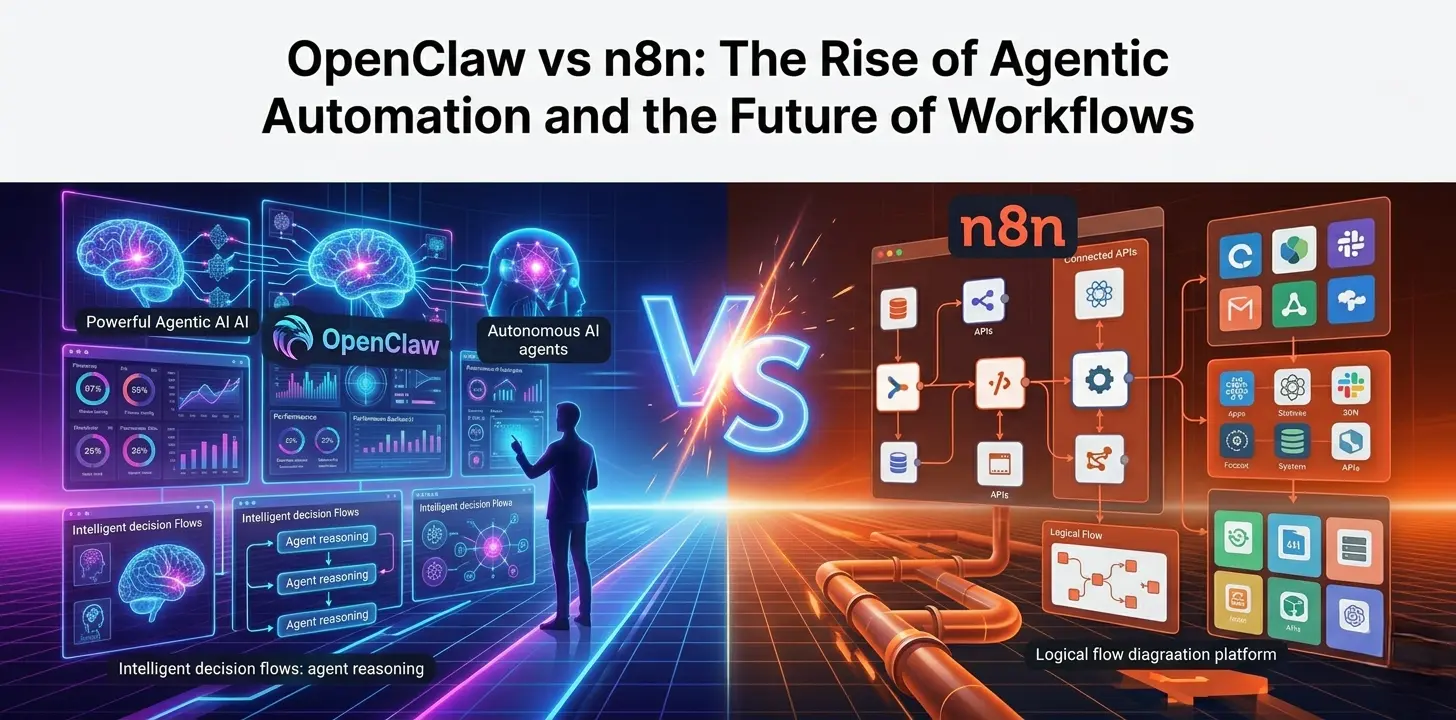
While platforms like n8n have long led the industry with their robust, visual workflow builders, a new challenger has emerged: OpenClaw. Representing the rise of AI-driven, agentic platforms, OpenClaw is changing the landscape by introducing workflows that don't just follow paths, but make real-time decisions. This guide explores the fundamental shift from deterministic logic to the intelligent reasoning offered by the OpenClaw ecosystem.
What is OpenClaw?
OpenClaw is an AI-first automation platform that prioritizes intent-driven execution over rigid process definitions. In traditional systems, you define every step; in OpenClaw, developers define the ultimate objectives and the constraints the system must respect. The underlying engine then determines the most effective sequence of actions dynamically.
This approach is tailor-made for agent-based architectures. It enables autonomous actions and intelligent decision-making, allowing the system to handle complex scenarios—such as interpreting a customer's tone or deciding which internal tool to query—without a human having to pre-program every possible branch of logic.
Why n8n Became the Industry Standard
To understand the rise of OpenClaw, we must acknowledge why n8n became so popular. It successfully bridged the gap between low-code ease and developer-grade power. Its primary strengths include:
Visual Workflow Builder
n8n’s node-based interface allows users to visualize the flow of data across hundreds of different services, making complex integrations much easier to design and troubleshoot.
Self-Hosting and Flexibility
Unlike many SaaS-only competitors, n8n offers a self-hosted version. This gives businesses complete control over their infrastructure and data privacy, which is vital for handling sensitive client information.
Extensive API Support
With a vast library of pre-built integrations and the ability to add custom logic via JavaScript nodes, n8n is highly effective for structured, predictable automation where the input and output are clearly defined.
Where Traditional Workflow Tools Fall Short
As business needs become more complex, traditional tools like n8n face significant challenges. The manual definition of every branch and condition creates 'logic debt.' As a workflow expands, it becomes increasingly difficult to maintain, and a single change in a third-party API can break an entire spiderweb of nodes.
Furthermore, traditional tools struggle with unstructured data. If an input doesn't fit a specific format, the workflow often fails. In these systems, AI is typically treated as an 'add-on'—a single node in a larger chain—rather than the core engine that drives the entire process from start to finish.
How OpenClaw is Changing the Game
OpenClaw addresses these shortcomings by integrating AI at the core of its execution logic. Instead of building a static map, you are essentially hiring a digital employee (an agent) that can plan, act, and adjust its behavior in real-time.
Reduced Manual Design
By defining 'intent' rather than every decision path, developers save hundreds of hours in manual configuration. Context interpretation allows the agent to decide which direction to take based on the data it receives, drastically reducing the size and complexity of the workflow definition.
Handling Ambiguity
OpenClaw excels at processing unstructured signals—like emails, chat transcripts, or market signals. It can interpret incomplete or ambiguous inputs to produce a meaningful result, something that would cause a traditional 'rule-based' system to crash or error out.
Real-World Use Cases: Which Should You Choose?
n8n: Best for Structured Operations
n8n remains the king of predictable, rule-based tasks. Examples include synchronizing data between a CRM and a marketing tool, sending automated notifications based on database triggers, or executing scheduled reporting tasks where the steps never change.
OpenClaw: Best for Autonomous Agents
OpenClaw is the superior choice for workflows that cannot be fully predicted. Consider an AI support agent that needs to analyze a query, search a knowledge base, check a user's subscription status, and then decide whether to issue a refund or escalate to a human. This level of reasoning is where agentic systems shine.
Cost, Infrastructure, and Scalability
There is a significant difference in how these systems scale financially. n8n's costs are primarily infrastructure-related—server compute and memory. Its costs are predictable because you know exactly how many times a workflow will run.
OpenClaw, however, introduces 'intelligence costs.' Every time an agent 'thinks' or reasons, it consumes AI model tokens. While this might lead to higher operational costs in the short term, it often results in a lower Total Cost of Ownership (TCO) because you spend far less on human engineering and manual maintenance as your business processes evolve.
Can OpenClaw and n8n Work Together?
For many modern enterprises, the answer isn't 'either/or'—it's 'both.' We are seeing a rise in hybrid architectures where OpenClaw acts as the 'Brain' and n8n acts as the 'Hands.'
In this model, OpenClaw interprets the goal and makes the high-level decisions. It then triggers specific n8n workflows via webhooks to execute the operational tasks, such as updating a legacy database or sending a formatted PDF. This combines the reasoning power of AI with the stability and transparency of traditional automation.
Conclusion: The Future is Agentic
OpenClaw represents more than just a new tool; it signals a generational shift in how we think about software. We are moving away from building static machines and toward nurturing intelligent ecosystems. While n8n will continue to be a vital tool for structured data orchestration, OpenClaw is leading the charge into a world where automation can reason, adapt, and grow alongside your business.
By strategically combining both platforms, organizations can build highly scalable, resilient, and intelligent digital environments that reduce human workload and drive unprecedented levels of business growth.