




1. Introduction: The Shift to 'Engineered' Automation
By 2026, automation has moved away from simple 'If This, Then That' triggers. We are now in the era of High-Fidelity Automation, where workflows must handle complex state management, error recovery, and AI-driven decision-making. While basic tools serve non-technical users, developers require a platform that offers the transparency of code with the speed of visual design.
n8n (Nodemation) has emerged as the industry standard for this middle ground. It is an open-source, node-based workflow engine that allows engineers to treat automations as first-class citizens in their tech stack. Whether you are syncing lead data across a CRM or orchestrating an autonomous AI agent, n8n provides the 'plumbing' necessary for modern software ecosystems.
2. What is n8n? (The 'Nodemation' Philosophy)
n8n is an open-source workflow automation tool that utilizes a unique Fair-Code model. Unlike closed-source competitors, n8n allows you to host the entire engine on your own infrastructure, ensuring 100% data sovereignty.
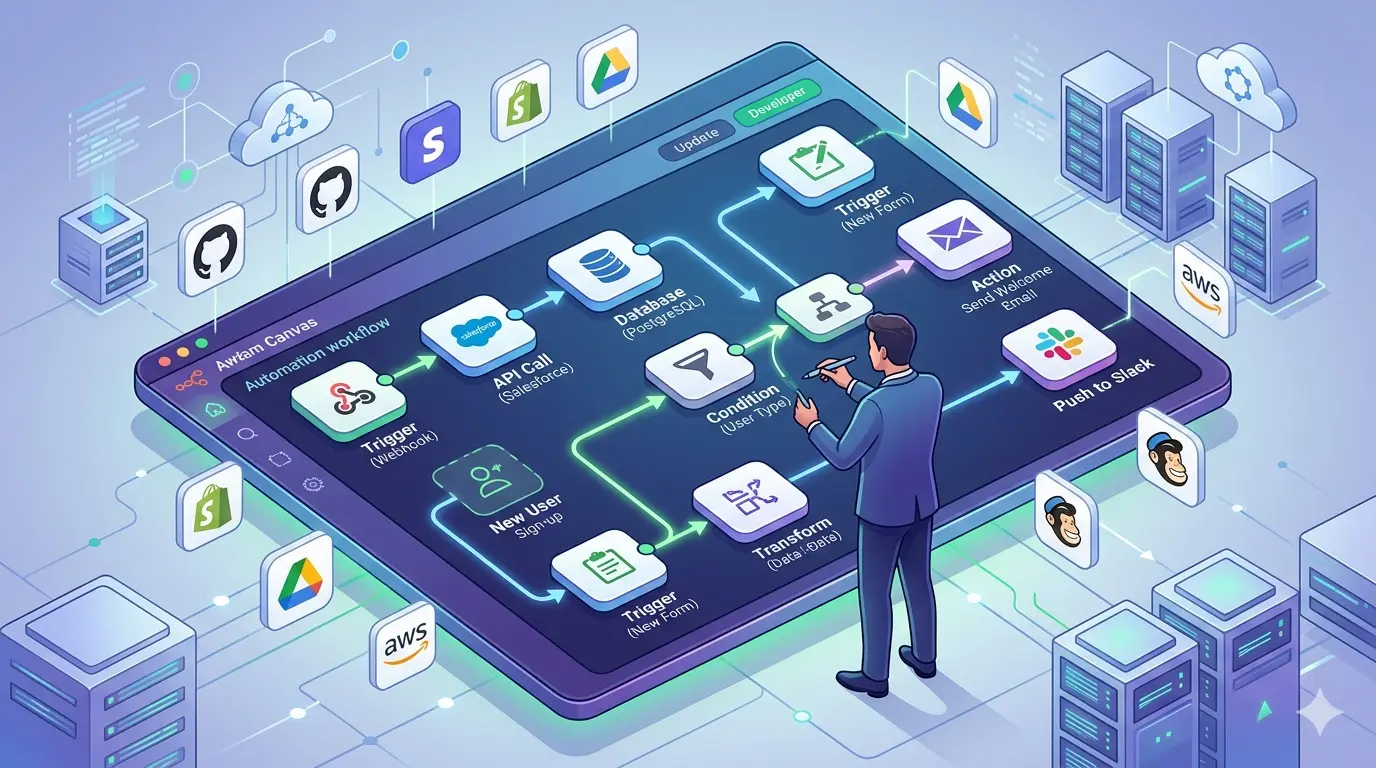
The platform operates on a Node-Based Architecture. Each 'Node' represents a discrete unit of logic or an API connection. By connecting these nodes on a visual canvas, you create a directed graph of data flow. This approach allows developers to visualize complex branching logic that would be difficult to track in a standard 1,000-line script, while still allowing for deep customization via JavaScript.
3. Why Developers Choose n8n Over Closed-Source Alternatives
- Infrastructure Control (Self-Hosting): For organizations dealing with sensitive PII (Personally Identifiable Information) or strict GDPR compliance, sending data to a third-party cloud is often a non-starter. n8n can be deployed via Docker on your own VPC, keeping data within your security perimeter.
- Custom Code as a First-Class Citizen: Most low-code tools hide logic behind rigid forms. n8n includes a 'Code Node' that lets you write standard JavaScript (Node.js) to manipulate JSON arrays, perform complex regex, or handle specialized data transformations.
- No 'Per-Execution' Tax: Many SaaS automation tools charge per successful task run. n8n’s self-hosted version allows for unlimited executions, making it the most cost-effective solution for high-volume data pipelines.
4. Understanding the Core Architecture: Triggers, Nodes, and Data Flow
A production-grade n8n workflow consists of three primary components:
- Triggers (The 'When'): These are the entry points. They can be Webhook-based (responding to an external push), Schedule-based (Cron jobs), or App-based (polling an API for changes).
- Nodes (The 'What'): Nodes are modular blocks. n8n offers 'Regular Nodes' for standard API actions (Slack, GitHub, Stripe) and 'Core Nodes' for logic (Merge, Filter, Switch, Split In Batches).
- The Data Structure (JSON): Data moves through n8n as an array of JSON objects. Understanding how to reference data from previous nodes using Expressions (e.g.,
{{ $json.id }}) is the key to building dynamic workflows.
5. Advanced Feature: AI & Agentic Orchestration
In 2026, the 'AI Node' in n8n is no longer just a wrapper for a chat prompt. n8n now serves as a powerful Agent Orchestrator.
- LangChain Integration: n8n natively supports LangChain components, allowing you to build 'chains' that include memory, document loaders, and vector store retrievers.
- Autonomous Agents: You can define 'Agent' nodes that use 'Tool' nodes (like a Google Search node or a Database node) to perform research and execute tasks autonomously based on a high-level goal.
- Vector Database Connectivity: Easily upsert or query vectors in databases like Pinecone or Weaviate directly within your workflow, enabling sophisticated RAG (Retrieval-Augmented Generation) systems.
6. Deployment Strategies for 2026
- Local Development: Run
npx n8nto start a local instance for rapid prototyping. - Production Docker Deployment: The most common approach. Using
docker-compose, you can set up n8n alongside a PostgreSQL database for persistent storage and a Redis instance for queue management. - Scalable Worker Mode: For enterprise loads, n8n supports a Worker-Leader architecture. You can spin up multiple 'Worker' containers that handle the actual execution of tasks, while the 'Leader' manages the UI and scheduling.
7. Security Best Practices
- Credential Encryption: n8n encrypts all stored API keys at rest. Ensure you back up your
N8N_ENCRYPTION_KEYenvironment variable; without it, you lose access to all credentials. - Network Isolation: If self-hosting, place n8n behind a VPN or use a Reverse Proxy (like Nginx or Traefik) with Authelia/Authentik for SSO (Single Sign-On).
- Scoped Webhooks: Always use 'Webhook Basic Auth' or secret headers to ensure that only authorized systems can trigger your workflows.
8. Frequently Asked Questions
Q: How does n8n handle errors in long workflows? Each workflow can have an 'Error Trigger' workflow attached to it. If any node fails, n8n can automatically trigger a separate workflow to send a Slack alert, log the error to Sentry, or attempt a retry logic.
Q: Can I version control my n8n workflows? Yes. n8n allows you to export workflows as JSON files. Many developers use the n8n API to automatically push these JSON files to a GitHub repository, enabling a GitOps-style workflow for automation.
Q: Is n8n faster than writing custom Python scripts? For integration-heavy tasks (connecting 5 different APIs), n8n is significantly faster because it handles the authentication, rate limiting, and data mapping visually. For heavy computational logic, a custom script or a 'Code Node' is still preferred.
Conclusion: The Future is Automated
n8n represents the evolution of the 'Glue Developer.' In a world where every service has an API, the value is no longer in writing the connection code, but in designing the logic of the flow. By mastering n8n, developers can build robust, scalable, and AI-powered systems in a fraction of the time it would take to build from scratch. As we move further into 2026, those who can orchestrate these digital 'crews' of nodes and agents will be the ones driving innovation in the enterprise.