


Introduction: What Are AI Agents?
AI agents are autonomous systems that perform tasks by reasoning through problems, using tools, and executing workflows without constant human input. Unlike traditional AI systems that respond to a single prompt, AI agents operate across multiple steps and maintain continuity in their execution. They can plan actions, evaluate outcomes, and adjust their behavior dynamically.
This concept is becoming important because the way AI is used is changing. Earlier, users interacted with models through isolated prompts. Today, businesses and developers require systems that can complete entire workflows such as research, data processing, decision making, and execution. AI agents address this need by functioning more like intelligent systems rather than simple response generators.
The Shift from Prompts to Autonomous Workflows
The transition from prompt-based systems to agent-driven workflows represents a fundamental shift in software design. Prompt-based AI is reactive and limited to single interactions, whereas agent-based systems are proactive and capable of managing ongoing processes.
This shift enables AI systems to execute tasks end-to-end. Instead of stopping at generating an answer, agents can retrieve data, analyze it, interact with APIs, and deliver final outputs. This evolution is redefining how automation is built, moving from isolated intelligence to continuous execution.
What Is a Software Development Kit (SDK)?
A Software Development Kit is a collection of tools, libraries, and APIs that developers use to build applications in a structured and efficient way. It provides predefined components and standardized methods that reduce the complexity of development.
In the context of AI agents, SDKs act as the foundation that brings together models, tools, memory, and workflows into a single system. Without SDKs, developers would need to manually integrate each component, which would increase development time and reduce reliability.
Why SDKs Are Critical for Agentic AI
AI agents involve multiple layers such as reasoning, tool usage, state management, and orchestration. SDKs simplify this complexity by providing abstraction and reusable components.
They allow developers to focus on defining the logic and purpose of the agent instead of building infrastructure from scratch. This results in faster development, better consistency across projects, and systems that are easier to scale and maintain. SDKs also improve the developer experience by offering debugging tools and structured workflows.
Google Agent SDK or Agent Development Kit Overview
Google’s Agent Development Kit, also known as the Google Agent SDK or ADK, is an open-source framework designed to build, test, and deploy AI agents. It provides a complete environment for creating autonomous systems that can operate in real-world scenarios.
The SDK integrates deeply with Google Cloud services and supports advanced AI models such as Gemini. This integration allows developers to move from experimentation to production without changing their development approach. The goal of the Google ADK is to standardize how agents are built and deployed at scale.
Architecture of Google Agent SDK
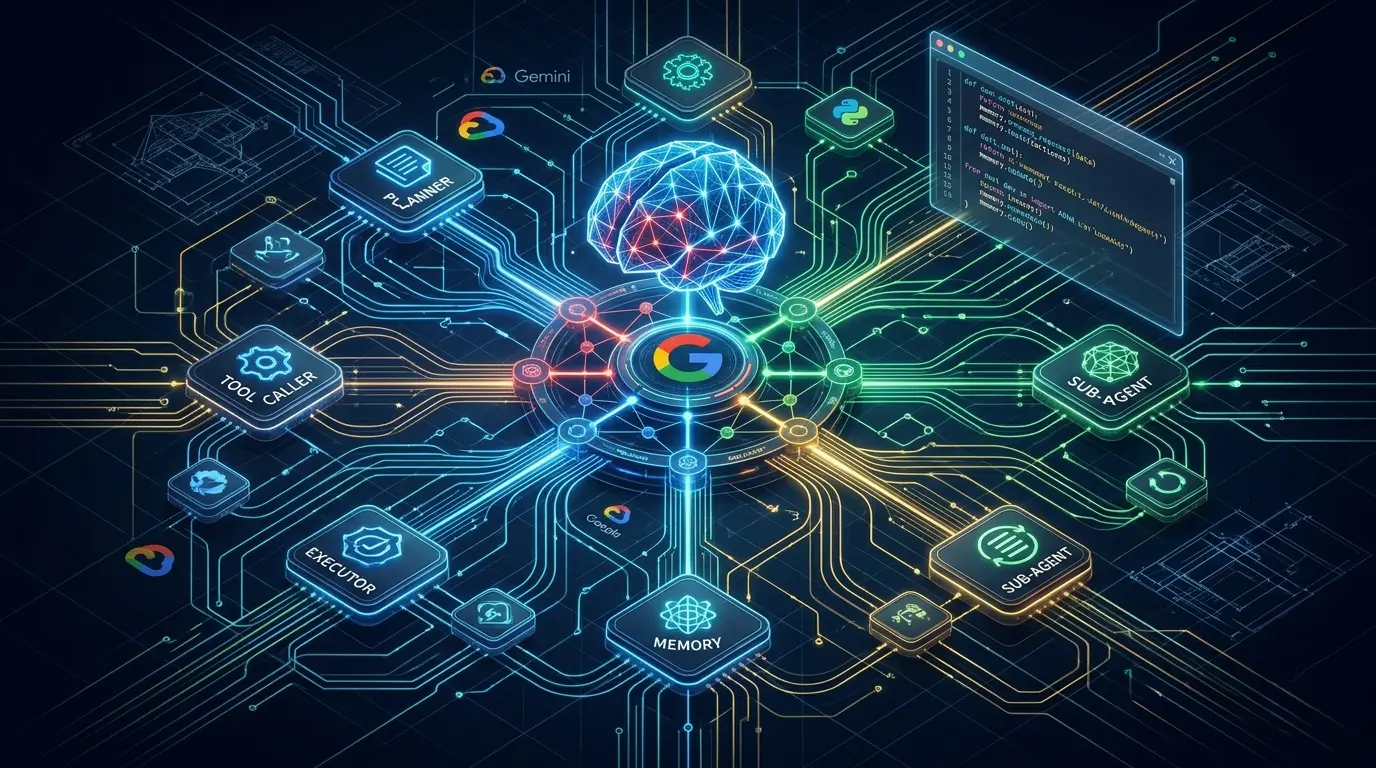
The architecture of the Google Agent SDK is based on modular layers that work together to create a complete agent system. Each layer is responsible for a specific function, and together they enable flexibility and scalability.
The model layer defines the intelligence of the agent by selecting the underlying AI model that powers reasoning and language understanding. The tooling layer allows the agent to interact with external systems such as APIs, databases, and services, enabling it to perform real actions instead of just generating responses. The memory layer ensures that the agent can retain context across interactions, which is essential for long-running tasks and personalized behavior. The orchestration layer manages how tasks are executed, including sequencing, branching, and coordination between multiple agents. The deployment layer ensures that the agent can run in scalable environments such as cloud infrastructure or containers.
Core Concepts of Google’s Agent SDK
Agent Definition
An agent is defined by its purpose, instructions, selected model, and available tools. This structured definition ensures that the agent behaves consistently and aligns with its intended function.
Tool Integration
Tool integration allows agents to perform actions beyond text generation. By connecting to APIs, databases, and external services, agents can retrieve information, execute operations, and interact with real systems.
Memory and Session State
Memory enables agents to maintain context across interactions. This allows them to understand previous steps, maintain conversation history, and make more informed decisions over time.
Workflow Orchestration
Workflow orchestration allows agents to execute complex processes. Tasks can be arranged in sequences, conditional paths can be created, and multiple agents can collaborate to complete larger objectives.
Technical Steps to Build an Agent
Building an agent using the Google Agent SDK begins with setting up the development environment by enabling necessary cloud services and configuring authentication. After this, the SDK is installed using appropriate package managers depending on the programming language being used.
Once the environment is ready, the developer defines the agent by selecting a model, writing instructions, and attaching tools. The agent is then tested locally to ensure that it behaves as expected, with debugging focused on tool interactions and workflow execution. After validation, the agent is deployed to a cloud environment where it can handle real-world tasks at scale.
Advanced Capabilities in Google Agent SDK
The Google Agent SDK supports advanced features that enable more sophisticated systems. It allows multiple agents to collaborate, where each agent is responsible for a specific task within a larger workflow. This modular approach improves scalability and maintainability.
Agents can dynamically select tools based on the task they are performing, which increases flexibility and efficiency. The SDK also supports context-aware reasoning, allowing agents to make decisions based on both current input and past interactions. Additionally, event-driven execution enables agents to respond to triggers such as API calls or system updates, making them suitable for real-time automation.
Performance Optimization Strategies
Optimizing agent performance requires careful design of workflows and resource usage. Efficient state management reduces redundant computations and improves speed. Optimizing tool interactions ensures that external API calls are fast and reliable. Clear and structured instructions improve the accuracy of the agent’s decisions. Monitoring and logging systems help developers track behavior and identify areas for improvement.
Security and Governance
As agents interact with real systems and data, security becomes a critical concern. Developers must implement access controls to restrict how agents use tools and APIs. Data privacy must be maintained, especially when handling sensitive information. Audit mechanisms should be in place to track agent actions and ensure accountability.
Future of Google Agents and SDK Ecosystem
The future of agent development is focused on increasing autonomy, improving integration, and enhancing scalability. AI agents are expected to become more deeply integrated into business processes and software systems. Advancements in multi-agent collaboration will enable more complex workflows to be automated. As the ecosystem evolves, Google’s Agent SDK is likely to play a central role in shaping how agentic systems are built and deployed.
Conclusion
Google Agent SDK represents a major advancement in the development of autonomous AI systems. It provides a structured and scalable approach to building agents that can perform complex tasks and operate in real-world environments.By combining powerful models, flexible tooling, and cloud based deployment, it enables developers to move beyond simple AI applications and build systems that act, decide, and execute. As agentic AI continues to grow, SDK based development will become the standard for creating intelligent and autonomous software systems.