



Artificial intelligence is transforming how businesses communicate with customers and automate workflows. Two technologies often discussed together are AI chatbots and AI agents. While they may appear similar at first glance, their capabilities and roles are very different.
Understanding the difference between AI agents and chatbots is important for companies that want to improve customer experience, automate operations, and use intelligent systems effectively.
This guide explains what chatbots and AI agents are, how they work, their key differences, and when businesses should use each technology.
What Is a Chatbot
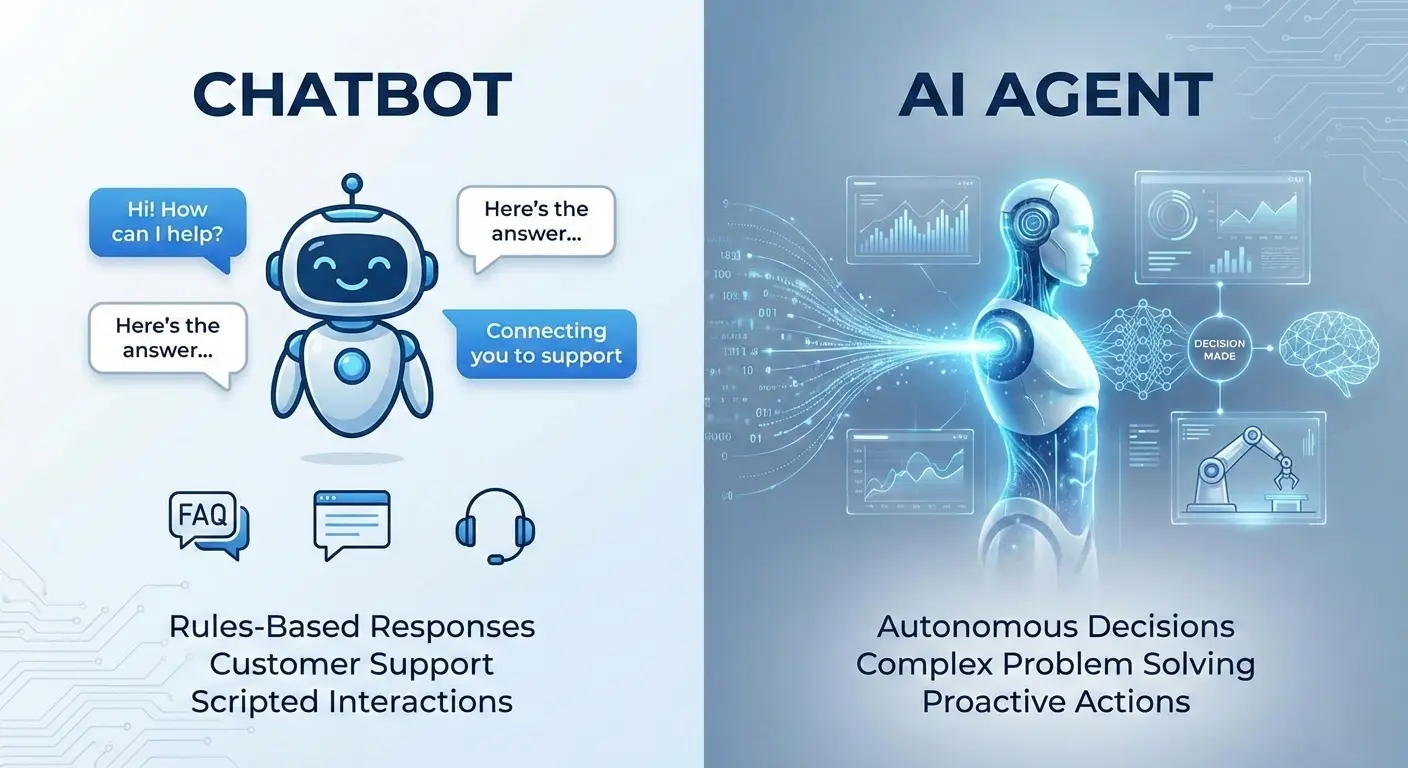
A chatbot is a software application designed to simulate conversations with users through text or voice. Chatbots usually appear on websites, messaging platforms, or mobile applications where they interact with customers and answer questions.
Most chatbots are created to handle simple and repetitive tasks. They follow predefined rules or rely on natural language processing to understand user input and generate responses.
Common chatbot functions include answering frequently asked questions, helping users track orders, scheduling appointments, and guiding customers through support requests.
Traditional chatbots operate in a reactive way. They respond when a user sends a message or asks a question. Their ability to make decisions is limited because they mainly retrieve information rather than analyze complex situations.
For many businesses, chatbots are useful for reducing customer support workload and providing quick responses to common inquiries.
What Is an AI Agent
An AI agent is a more advanced form of artificial intelligence designed to perform tasks, make decisions, and execute actions to achieve specific goals.
Unlike chatbots, AI agents are not limited to conversations. They can analyze data, interact with multiple systems, and complete multi step workflows automatically.
AI agents combine several technologies including machine learning, large language models, reasoning systems, and automation tools. This allows them to understand context, evaluate options, and take the best action based on available data.
Instead of simply answering a question, an AI agent might analyze customer behavior, update a database, send notifications, and trigger follow up actions without human involvement.
Because of this capability, AI agents are increasingly used in complex business processes such as sales automation, customer support operations, workflow management, and predictive analytics.
How Chatbots Work
Chatbots typically follow structured logic that allows them to respond to specific inputs. The system receives a user message, interprets the request, and selects an appropriate response.
Many chatbots rely on one of three approaches.
Rule Based Systems
These chatbots follow predefined decision trees. If a user asks a specific question, the chatbot returns a scripted answer.
Keyword Recognition
The chatbot identifies keywords in a message and matches them with responses stored in a knowledge base.
Natural Language Processing
More advanced chatbots use NLP to understand the meaning behind user queries and respond more naturally.
Despite these improvements, most chatbots still operate within a limited environment. They cannot easily perform complex reasoning or execute tasks across different systems.
How AI Agents Work
AI agents operate differently from traditional chatbots. Instead of only responding to messages, they follow a goal oriented process.
An AI agent usually performs three main steps.
Perception
The system gathers information from data sources, applications, or user input.
Reasoning
The agent analyzes the information and determines the best course of action.
Action
The system executes tasks such as updating records, sending emails, assigning leads, or triggering workflows.
Because AI agents can access multiple tools and systems, they can complete complex processes that would normally require several human steps.
Key Differences Between AI Agents and Chatbots
Although chatbots and AI agents are both powered by artificial intelligence, their capabilities differ significantly.
Purpose
Chatbots focus on conversations. Their main role is to answer questions and guide users through simple tasks.
AI agents focus on achieving goals. They analyze data, make decisions, and execute actions that support business processes.
Level of Autonomy
Chatbots usually depend on user input. They respond when a customer asks a question or initiates a conversation.
AI agents operate with greater autonomy. They can monitor data, detect patterns, and take action without waiting for user instructions.
Decision Making Ability
Chatbots rely on predefined responses or simple intent recognition.
AI agents evaluate context, analyze multiple data sources, and determine the best possible outcome before acting.
Integration with Systems
Chatbots typically connect to a small number of systems such as a knowledge base or customer support platform.
AI agents integrate with many tools including customer relationship management systems, analytics platforms, billing software, and workflow automation systems.
Business Impact
Chatbots mainly improve customer interaction and reduce support workload.
AI agents improve operational efficiency by automating decision making and managing complex workflows.
Use Cases for Chatbots
Chatbots remain valuable for many businesses because they handle high volume conversations efficiently.
Customer Support Automation
Chatbots answer frequently asked questions and help users find information quickly.
Order Tracking
Customers can check shipment status and delivery details without contacting support teams.
Appointment Scheduling
Businesses use chatbots to manage booking requests and availability.
Employee Assistance
Internal chatbots help employees access company policies, HR information, or technical documentation.
These tasks are simple, repetitive, and highly conversational, making them ideal for chatbot automation.
Use Cases for AI Agents
AI agents are designed for more advanced business processes where automation and decision making are required.
Sales Lead Qualification
AI agents analyze visitor behavior, evaluate lead quality, and assign prospects to the right sales representative.
Customer Churn Prediction
The system identifies customers at risk of leaving and triggers retention strategies automatically.
Revenue Forecasting
AI agents analyze sales pipeline data and predict future performance.
Workflow Automation
Agents manage tasks across multiple platforms such as CRM systems, marketing tools, and data platforms.
These applications go beyond conversation. They involve planning, reasoning, and execution.
Benefits of Chatbots
Chatbots provide several advantages for businesses.
Fast Customer Responses
Chatbots can answer questions instantly, reducing waiting times.
Cost Reduction
Automating repetitive conversations lowers support costs.
Scalability
A chatbot can handle thousands of conversations simultaneously.
Improved Customer Accessibility
Customers can receive assistance at any time of day.
Benefits of AI Agents
AI agents offer a deeper level of automation and intelligence.
Advanced Automation
Agents can complete multi step tasks without manual input.
Better Decision Support
They analyze large amounts of data to recommend or execute actions.
Improved Operational Efficiency
Businesses can automate complex workflows that previously required human teams.
Proactive Operations
AI agents monitor systems and respond to events before problems escalate.
Will AI Agents Replace Chatbots
AI agents are more powerful than chatbots, but this does not mean chatbots will disappear.
In many cases, both technologies work together. Chatbots handle front line conversations with users, while AI agents operate behind the scenes to analyze information and manage workflows.
For example, a chatbot may collect customer information during a conversation. An AI agent then processes that information, assigns the request to the correct team, and updates internal systems.
This combination allows organizations to deliver fast customer support while still benefiting from advanced automation.
How Businesses Should Choose Between AI Agents and Chatbots
The choice between chatbots and AI agents depends on the complexity of the problem a business wants to solve.
If the goal is to answer questions, guide users, or provide simple support, a chatbot is usually sufficient.
If the goal is to automate decision making, manage workflows, or analyze large amounts of data, an AI agent is a better solution.
Organizations should also consider their data infrastructure, integration requirements, and long term automation strategy before selecting the right technology.
Future of AI Agents and Chatbots
The evolution of artificial intelligence is rapidly changing how companies build digital experiences.
Chatbots are becoming more conversational and intelligent as natural language models improve. At the same time, AI agents are expanding into complex roles such as research automation, business analysis, and operational decision making.
As these technologies continue to develop, businesses will increasingly rely on both systems to create efficient and intelligent digital environments.
Conclusion
AI agents and chatbots are both powerful tools in modern artificial intelligence, but they serve different purposes.
Chatbots focus on conversations and help businesses handle customer interactions efficiently. AI agents go further by analyzing data, making decisions, and executing actions across multiple systems.
Understanding the difference between these technologies helps organizations choose the right solution for their automation strategy.
For simple communication tasks, chatbots remain highly effective. For complex workflows and intelligent automation, AI agents provide a more advanced approach.
Companies that combine both technologies strategically can create scalable systems that improve customer experience, reduce operational workload, and drive business growth.